Showing posts with label Bill Clinton. Show all posts

Tuesday, February 21, 2017

What's with the Shamrocks?


Each year the Irish Prime Minister (An Taoiseach) visits the White House on or around St. Patrick's Day for what has become known as the Shamrock Ceremony, where he presents a Waterford Crystal bowl filled with shamrock to the President of the United States in recognition of the two countries special bond. The official exchange and photo op is joyfully followed by a festive reception for guests at the White House. The festivities actually begin much earlier in the day with a sit down St. Patrick's Day lunch. This tradition began, on a much smaller scale, during the Truman administration when, in 1952, the Irish Ambassador to the US John Hearne dropped off a box of shamrock plant to the White House. Ironically President Truman was not home at the time but rather on vacation. 

So what's all the fuss about? 

To answer that question we need to go back to the founding of the countries. Anyone who has read modern history would have little choice but to appreciate the strong connection between the US and Ireland. A few notables: 

  • Of the 56 signers of the Declaration of Independence eight (8) were Irish Americans, three (3) of whom were Irish born - James Smith, George Taylor and Matthew Thornton. 
  • Many Irish fought and died in the American Civil War. 
  • The Irish Proclamation of Independence (Easter Proclamation) of April 24, 1916 specifically mentions America in its text: 
"... she (Ireland) now seizes that moment, and supported by her exiled children in America ..."

America continued to be a bastion of support for Irish independence and consequently for peace in the northern part of the country. Many Irish of course immigrated to the United States to work and send money back home to aid their families in Ireland. The first shamrock ceremony, as referenced earlier, was post World War II and there is some thought that Hearne was motivated to try and warm the relationship with the US given Ireland's neutrality during the war. 

With different administrations came different levels of interest in the tradition. Obviously the election of John F. Kennedy was a game changer in terms of recognition and appreciation of not just Irish heritage but also Catholicism. As the first Catholic ever elected to the Office of the President, JFK was the embodiment for so many Irish and Irish Americans of what they and their families had sought - recognition, acceptance and, most of all, respect. Other Administrations followed and all maintained the shamrock ceremony on or around St. Patrick's Day. President Ronald Reagan, a very proud Irish American, found particular enjoyment with the ceremony and added speaking programs as a way to educate Americans about the current state of affairs in Ireland, as did President Bill Clinton. Clinton, however, changed the dynamic considerably by adding a political element in his proactive and unwavering support of peace in Northern Ireland. His interest was made clear early on when as a candidate he acknowledged that he would advocate for a visa for Gerry Adams - the leader of the Sinn Fein political party in Northern Ireland. It was a risk as both a candidate and as a President but the gamble paid off and Clinton's administration was integral in helping to shape and realize the Good Friday Agreement, with incredible contributions from people like former Senator George Mitchell. Accordingly, Clinton's White House St. Patrick's Day guests included not only An Taoiseach and the Ambassadors but also the political leaders from Northern Ireland - a first. 


Today the ceremony is mainly celebratory where the political leader of Ireland is provided a unique opportunity to present his American "wish list" for Ireland to the leader of the free world. In recent years, a key focus has been the economic ties between Ireland and the US, particularly foreign direct investment from America into Ireland, and immigration reform to assist the undocumented Irish in America. 

This year's St. Patrick's Day visit will be interesting to say the least. The political climate in both countries is, in many respects, unprecedented. Despite considerable criticism he has received at home, Taoiseach Enda Kenny is scheduled to travel to the US for St Patrick's Day to visit with President Trump. The traditional asks on behalf of his country, however, will be met with a different set of ears than he may be used to. Trump has demonstrated a very different view of immigrants than that of, at the very least, his immediate predecessor and many believe is uninterested in working to find ways to integrate any of the so-called undocumented - Irish or otherwise. Further, he supports a tax on imported American goods which are produced by American companies abroad and wants to see a revamp of the US tax code, which in part will be aimed at enticing US companies with foreign HQs and/or operations to physically and legally return home. Many such US companies currently call Ireland home. 

Unfortunately for Enda Kenny, this could very well be his last visit to the White House as Taoiseach. He is currently under considerable political stress in his own government and could quite possibly be out of office in 8-10 weeks time. Add to all of this the sobering consequences of Brexit and the possibility that Ireland may be forced back to the days of a physical border between the Republic and the 6 counties of the North, it makes for a critically important and potentially challenging exchange between the two leaders over the shamrock bowl. 

Regardless of politics, it is indeed encouraging to see that the time honored tradition of the shamrock ceremony will continue into the Trump Administration. It could even lead to other things in the future. I have no idea if President Trump has any Irish heritage. President Obama did not learn of his Irish lineage until he was in the White House - a fact he pointed out at one of his St. Patrick's Day lunches by commenting that such knowledge, as a son of Chicago, could have delivered him to Washington "sooner". Could there be a Moneygall in Trump's future? We can only speculate - I for one would be curious to see the kind of reception he would receive compared to the likes of Kennedy and Obama. 

Monday, September 14, 2009

EDWARD MOORE KENNEDY 1932-2009


SENATOR TED KENNEDY – A HERO FOR OUR TIME

The following is an entry by TMG’s Principal Sean P. Moynihan expressing his appreciation of the life and work of Senator Ted Kennedy.  While in many respects it is not a unique story, it is significant as it represents Mr. Moynihan’s respect for a man who, from the time Sean was born up until a few weeks ago, served tirelessly on his behalf in the United States Senate. 
 
It was shortly after the 1992 Clinton/Gore campaign took off that I realized I had a strong interest in and passion for politics.  Until that time, public policy matters and the political arena were considerations I gave very little thought or time to - as I suppose was the case for many adolescents.  I held such ambivalence despite the fact that my father, a former public school teacher and union representative on behalf of public school teachers, had always been an outspoken advocate of liberal politics and that my family had always been strong and vocal supporters of the Kennedys - which was readily apparent by the photographs and books of Jack and Bobby as well as numerous dinner table discussions at my home.  I remember my mother – also a public school teacher - commenting on how the Clinton/Gore ticket reminded her of JFK in 1960 and how hopeful and excited she was at that time with the prospect of a bright, young Irish Catholic from Massachusetts assuming the presidency of the United States.  My experiences in volunteering for Clinton/Gore as well as those of my first job out of college – working for the United Way of Central Massachusetts in Worcester, MA – stirred, or perhaps awakened, a strong interest in public service.  

I soon realized that I had strong opinions about the role of our government and that those opinions were indeed of the liberal persuasion – in no small part I am certain due to the influence of my folks.  But more significantly, I realized that my ideals and vision for government was shared by my Senator in the United States Congress – Ted Kennedy.  From that time forward, he became a true inspiration to me - not merely because of the policies for which he supported and fought, but also because of the extent to which he fought for them.  I found myself inspired but also intrigued that a man who came from such privilege and good fortune would dedicate - in some cases sacrifice - his personal and professional life to others who couldn’t advocate for themselves.  His efforts in this regard rang true with so many teachings of my family and my faith that I hoped for an opportunity to someday acknowledge my appreciation and perhaps work on his behalf. 

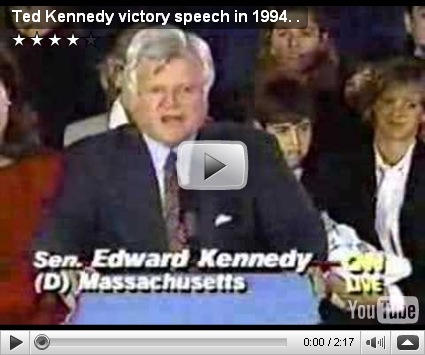
Such an opportunity came in 1994 when a young and successful republican business man named Mitt Romney decided to challenge the Senator.  That campaign was significant in two ways: first, it provided me with an opportunity to indeed acknowledge and thank Senator Kennedy in a tangible way; and second it baptized me into the world of politics.  I remember feeling rather skittish before attending my first campaign meeting at Mike Donoghue’s house in Worcester.  What in the world could I, a virtual political neophyte, bring to the table in support of Ted Kennedy?  I quickly learned that in campaigns - no matter how small the effort – there is always work to be done and there can never be too much support – particularly in this case as there was a theory espoused by some, soon to be debunked, that Teddy had become what one pundit charged, “Jurassic” and “out of touch” with the people of Massachusetts and their needs in Washington.  As someone in his early 20s, it was a message that I vehemently disagreed with and one that would soon galvanize Kennedy supporters and lead him to a resounding victory. 


During that campaign I was impressed with how accessible the Senator and his campaign staff were.  I had the opportunity to meet him several times and there was always a firm handshake and a sincere expression of thanks for my efforts.  That campaign was also significant as it introduced me to another candidate at the time – Harold Naughton of Clinton, MA – who was running for State Representative from my hometown’s district.  I would work extremely hard on this campaign as well and soon join the new state representative in Boston. 
During my years at the State House, there were many times when I needed to reach out to Senator Kennedy’s offices in Boston and in Washington.  Without exception, the issues facing the constituents on whose behalf we were calling were successfully addressed within a 24-48 hour period.  The expediency with which the Senator’s office addressed the needs and interests of the people of Massachusetts was truly remarkable and consequently my support of him only magnified.  Again in 2000, although unopposed, and this time as chairman of my hometown’s Democratic committee, I worked on the Senator’s campaign and that of Vice President Al Gore and again my efforts were acknowledged by the Senator.  
 
Sean with Senator
Scan of letter


Although it has been referenced numerous times over the period of the past few weeks, I always found Ted Kennedy’s ability to continue on in public life despite the numerous tragedies that had befallen his family truly remarkable. Further, his critical support of his nieces and nephews in times of need clearly made a difference in their lives, as many of them have so acknowledged. Perhaps Vice President Joe Biden summarized Senator Kennedy’s life best when he said, “… the unique thing about Teddy was it was never about him. It was always about you. It was never about him.”

On Friday morning August 28th, my 3 year old daughter Maeve and I paid our respects to Senator Kennedy as he lay in repose at the JFK Library and Museum in Dorchester. When the inevitable time came to explain why we were there, the challenge of an explanation to a 3 year old stumped me, but to my surprise my wonderful wife had already anticipated the moment and Maeve told me we were there to say “thank you and goodbye”. My pride could not be put into words. As she and I entered the library she intuitively knew … “Daddy, we have to be quiet”. As we entered the Smith Center we encountered the changing of the guard and stopped close to the casket. Maeve didn’t utter a word. When I told her it was time to continue on, she looked up at me and smiled. Unwittingly she put me at peace and put into perspective, in many respects, what Ted Kennedy stood for. We paid our respects and I thanked God for the gift of my little “pumpkin” who was there for me.

Ted Kennedy bore the burden of his father’s ambition, his brothers’ legacies, a nation’s hopes, and a Commonwealth’s needs, and in my estimation, we are all the better for it. As we look to an uncertain future without the guiding hand of Senator Kennedy in Washington, it is my hope that the example of his life as a true advocate will continue to serve as an inspiration to others as it did to me. It is with these thoughts that I believe “the dream lives on.”

Thank you Senator and God Bless you.